 Apsis
Arrow puzzle strategy: read the path before you tap
Learn how to read arrow escape puzzles: check the full path, allow for width, notice special rules and scan again after each move, with Apsis examples.
 , updated , 4 min read
The most useful habit in an arrow escape puzzle is to trace the whole path before tapping. An arrow pointing towards the edge can still have something in its way. A clear-looking centre line can still leave too little room for the arrow itself.
I make Apsis, where arrows sit on orbits but usually leave along straight paths. These are the reading habits I use there, with the limits of each habit stated alongside it. Other arrow games can use different movement, collision and special-piece rules, so check their instructions before applying the same advice.
1. Follow the direction, not the decoration
Start at the arrowhead and follow its direction all the way to the exit. Look for obstacles anywhere along that route, including beyond the nearest row or ring. Do this before committing the move.
In an ordinary Apsis flight, the curved orbit shows where the arrow rests. It does not turn a straight flight into a circular one. An obstacle on a different orbit can therefore block the arrow. Later rules can change a flight, so the preview matters more than the background.
2. Check the whole width of the path
In Apsis an arrow has width. Its flight sweeps a band, and another piece can touch that band without touching its centre line. That is why a narrow gap can look safe and still cost a heart.
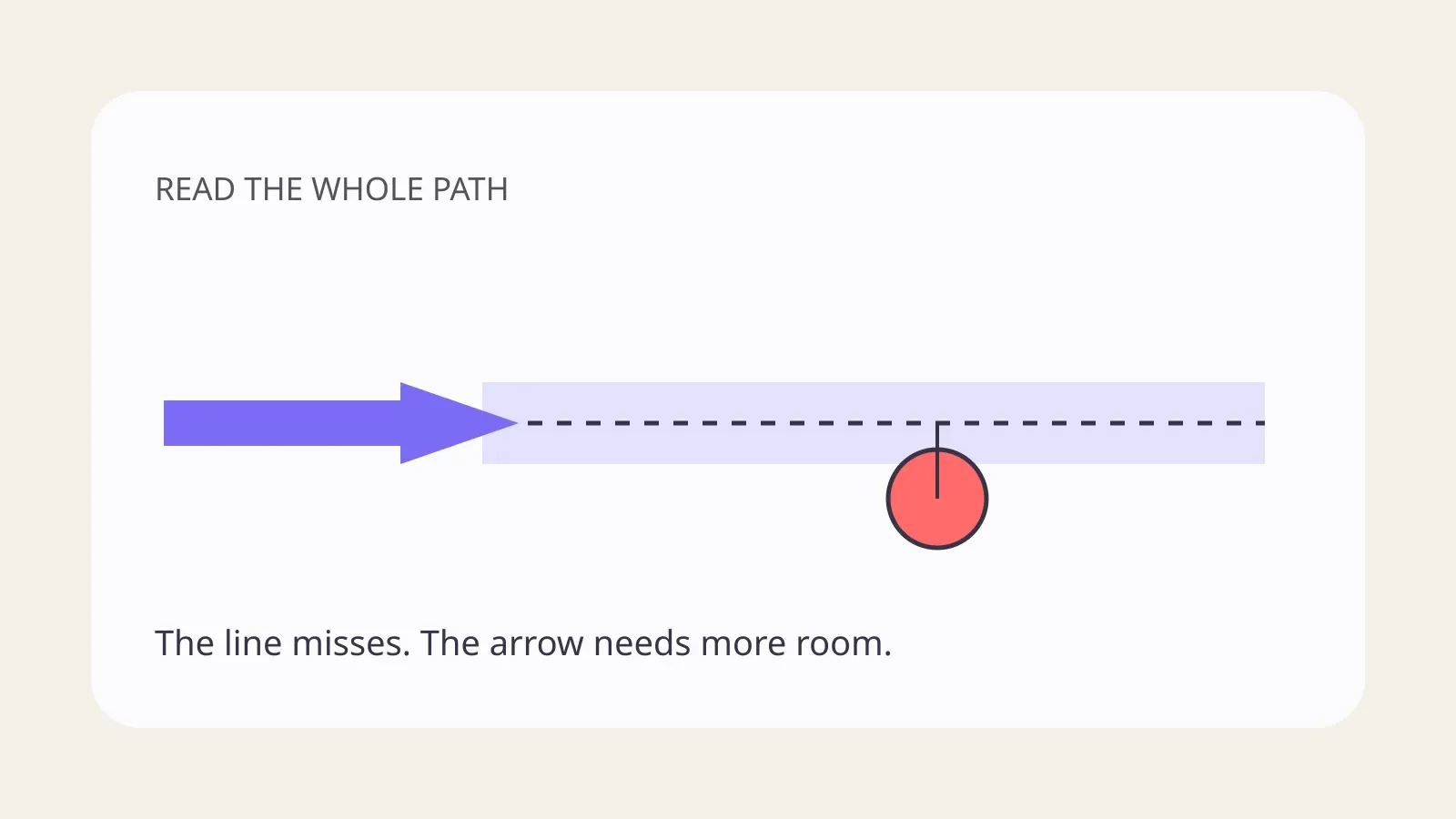
The diagram below isolates this one idea. It is an illustration of clearance, with invented dimensions, rather than a board from the game. Move the obstacle away from the line and compare the two readings.
A clear line needs room around it
Move the round obstacle. The shaded band is the space swept by a 24-unit-wide arrow.
The centre line misses. The full arrow still touches the obstacle.
Here the arrow is 24 units wide and the round obstacle has a radius of 14 units. The centre line misses the obstacle once its centre is more than 14 units away. The full band needs more than 26 units of separation: half the arrow’s width, 12, plus the obstacle’s radius, 14. Those numbers describe this drawing only.
When a gap looks close in Apsis, hold the arrow to inspect its path. Slide off into open space to cancel if you do not want to launch it. The preview is more useful than guessing from a small arrowhead.
3. Read special marks before looking for an exit
A clear geometric path is only one condition. A marked piece may be waiting for another event. In Apsis, for example, a locked arrow waits for its key, and numbered arrows have an order. Other pieces can change what blocks a path or what happens after a tap.
Ask two separate questions: can this piece leave under its own rule, and is its route clear? If the first answer is no, searching the route more carefully will not help yet. The Apsis rules guide explains the starting controls.
4. Make one move, then inspect what changed
After an arrow leaves, look at the space it occupied. Which routes passed through it? Those are useful places to inspect next. This is a smaller job than treating the entire board as unfamiliar after every tap.
On a plain removal board, taking away a piece cannot add a new geometric obstacle. That explains why an already clear route stays geometrically clear. It does not mean that move order is irrelevant in every arrow game or every special-piece chapter. Rewards, transformations and other rules need their own reading.
I use a simple rhythm: inspect, launch, inspect again. I avoid queuing several guesses while the first move is still playing out.
5. Use a hint to understand a dependency
When you ask for a hint, pause before following it. Look at the suggested piece and work out what it was holding back. That gives you a reason to recognise on the next board.
The Apsis hint considers both free pieces and special situations. There is a separate explanation of how its hint chooses a move. A hint is useful help, and using one is a normal way to learn the rules.
A quick checklist for a crowded board
- Read the piece’s mark and its movement rule.
- Follow its full route to the exit.
- Allow for the width of the moving piece.
- Use the preview when two pieces look close.
- After moving, inspect the routes that piece was blocking.
These habits are about understanding a board, rather than memorising a particular answer. If the orbital version interests you, see Apsis and get it on Google Play.
The examples follow Apsis’s current rules and its straight-path explanation. The diagram’s clearance is calculated from the two dimensions shown, so you can check the arithmetic yourself.